Linear Regression vs Logistic Regression
- Authors
- Name
- Amit Shekhar
- Published on


Linear Regression predicts a continuous value, like the price of a house, whereas Logistic Regression predicts a category, like whether an email is spam or not.
In this blog, we will learn about Linear Regression vs Logistic Regression in Machine Learning.
I am Amit Shekhar, Founder @ Outcome School, I have taught and mentored many developers, and their efforts landed them high-paying tech jobs, helped many tech companies in solving their unique problems, and created many open-source libraries being used by top companies. I am passionate about sharing knowledge through open-source, blogs, and videos.
I teach AI and Machine Learning at Outcome School.
Let's get started.
In machine learning, the two fundamental algorithms you will frequently encounter are Linear Regression and Logistic Regression. Although they sound similar, they are designed for fundamentally different tasks. Understanding their differences is crucial for choosing the right one. Let's explore what they are, how they work, and when to use them.
But before diving into the algorithms, it's important to understand the difference between regression and classification.
Regression
It predicts a continuous value.
A continuous value is numeric and can take any value. These values are measurable such as temperature, height, weight, or house prices.
Example: Predicting house prices, temperature, or stock prices.
Classification
It predicts a categorical value.
A categorical value, on the other hand, represents discrete groups or classes. These values are descriptive and usually non-numeric, like "yes/no," "red/blue/green," or "spam/not-spam." Categorical values are used in classification problems, where the aim is to assign inputs to a specific category or class.
Example: Predicting whether an email is spam or not, or whether a patient has a disease or not.
Once such a classifier is built, its quality is measured using Precision and Recall. We have a detailed blog on Precision vs Recall that explains how both work.
Now it's time to jump into our main topic: Linear Regression vs Logistic Regression. Let's start with Linear Regression.
Linear Regression
Linear Regression is one of the most basic algorithms in supervised learning. It is used to predict a continuous value based on one or more input features.
Most importantly, it predicts a continuous value using a linear relationship between inputs and output.
Linear Regression uses a simple linear equation for the input variables (x) and the output variable (y):
y = w1 × x1 + w2 × x2
x1,x2are input features.w1,w2are weights.yis the predicted continuous value.
The algorithm finds the line (or hyperplane in multiple dimensions) that best fits the data by minimizing the Mean Squared Error (MSE) between predicted and actual values.

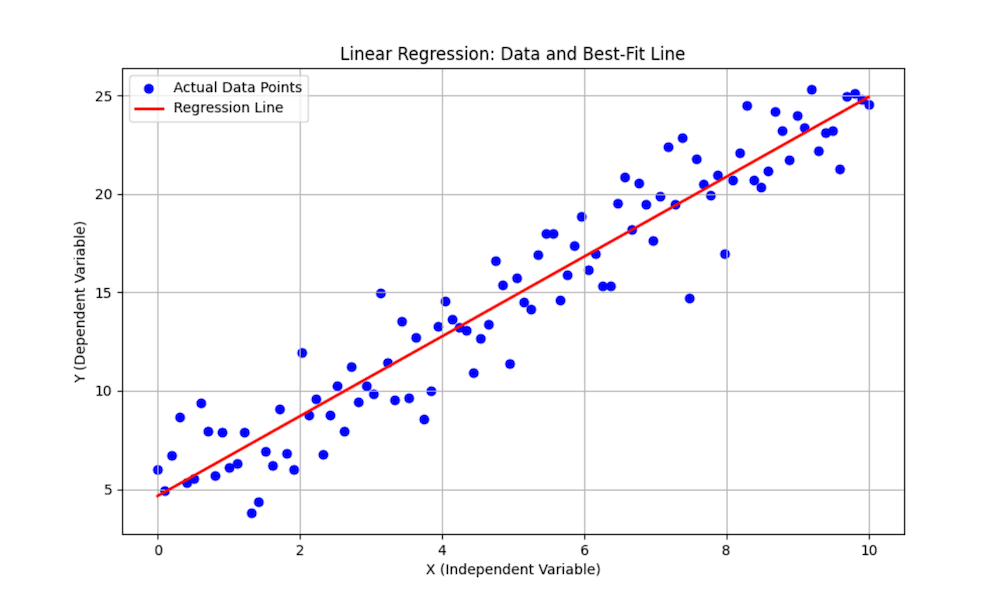
Linear Regression fits a straight line to predict a continuous numeric value, with no limits on the output range, it can go below 0 or above 1.
And finally, as a prediction, we get a continuous value.
Example: Predicting house prices based on size and location.
This was all about the Linear Regression. Now it's time to learn Logistic Regression.
A quick note for you
No matter which tech domain you work in, get familiar with these topics:
- LLM
- RAG
- MCP
- Agent
- Fine-tuning
- Quantization
We put it all together in one video:
AI Engineering Explained: LLM, RAG, MCP, Agent, Fine-Tuning, and Quantization
No need to stop reading - bookmark it and watch later when you get time. Future you will thank you.
Now, let's get back to the topic.
Logistic Regression
Logistic Regression, despite its name, is used for classification problems in supervised learning, not regression. It predicts the probability that a given input belongs to a particular class.
It starts with the same linear combination of inputs:
z = w1 × x1 + w2 × x2 // notice we’re using z instead of y
Then applies the sigmoid (logistic) function:
y = σ(z) = 1 / (1 + e^(-z))
This converts the raw value z into a probability between 0 and 1.
That probability is then converted into a class:
- If probability ≥ 0.5 → Class 1
- If probability < 0.5 → Class 0
The model is trained using Cross-Entropy loss function. This loss function is mainly used for classification problems.

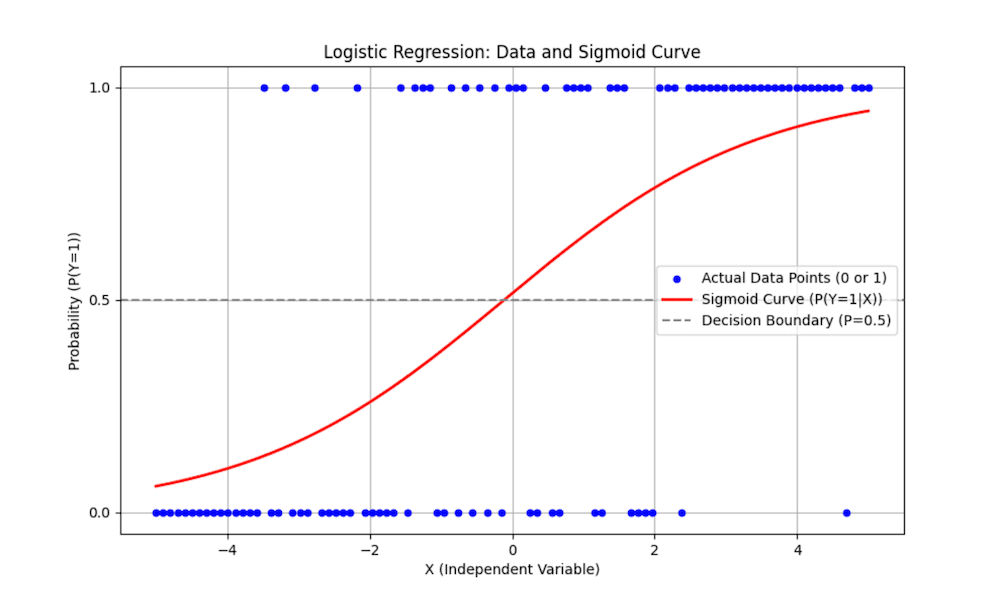
Logistic Regression uses an S-shaped curve (Sigmoid) to predict the probability, which is always restricted to the range [0, 1].
And finally, as a prediction, we get probabilities, that works well for classification.
You might be wondering: if the algorithm is used for classification, why is it called Logistic Regression, especially the "Regression" part of the name?
The name comes from the way the model is built, not the task it performs.
Logistic Regression actually starts by doing something that looks exactly like linear regression. It takes the input features and forms a linear combination:
z = w1 × x1 + w2 × x2
This part is literally a regression-style calculation, nothing about classification yet.
Then comes the twist: instead of using z directly, the model passes it through the logistic (sigmoid) function to convert it into a probability between 0 and 1:
y = σ(z) = 1 / (1 + e^(-z))
That probability is then used to decide the final class.
So even though the final outcome is classification, the model's internal mechanics are:
- Linear regression-like equation
- Followed by a logistic transformation using sigmoid function.
- Producing probabilities for classification
Because the core computation is regression-based, the name "Logistic Regression" remained, even though we use it for classification.
That's why the name is Logistic Regression.
So, this was all about the Logictic Regression.
To master Linear Regression, Logistic Regression, Cross-Entropy, and gradient descent end to end, check out our AI and Machine Learning Program at Outcome School.
Differences Between Linear Regression and Logistic Regression
Let's summarize the differences in a tabular format.
| Linear Regression | Logistic Regression |
|---|---|
| Regression: Continuous value | Classification: Probability (0–1) → Class |
| y = w1 × x1 + w2 × x2 | z = w1 × x1 + w2 × x2 → y = sigmoid(z) |
| Loss Function: Mean Squared Error | Loss Function: Cross-Entropy |
| Examples: House price, temperature | Examples: Spam detection, disease prediction |
| Use it when the target is continuous | Use it when the target is categorical |
I hope this explanation helped.
You can find the complete code that contains the implementation of linear regression and logistic regression from scratch. Check Build your own X - Machine Learning
Stay updated: Subscribe to our newsletter to get our latest AI and Machine Learning blogs straight to your inbox.
Frequently Asked Questions
Is Logistic Regression used for regression or classification?
Logistic Regression is used for classification, not regression. It predicts the probability that an input belongs to a particular class. The name comes from the way the model is built, since it starts with a regression-style linear equation before applying the sigmoid function.
What is the difference between regression and classification?
Regression predicts a continuous value, and classification predicts a categorical value. A continuous value is numeric and measurable, like temperature, height, or house prices. A categorical value represents discrete groups, like spam or not spam, so the aim is to assign each input to a class.
Can Linear Regression predict values below 0 or above 1?
Yes. Linear Regression fits a straight line, so its output has no limits on range and can go below 0 or above 1. Logistic Regression is different. It passes the value through the sigmoid function, so the output is always a probability between 0 and 1.
Which loss function does each model use?
Linear Regression uses Mean Squared Error, and Logistic Regression uses Cross-Entropy. Linear Regression finds the line that best fits the data by minimizing the Mean Squared Error between predicted and actual values. Cross-Entropy is mainly used for classification problems, which is why Logistic Regression is trained with it.
How does Logistic Regression turn a probability into a class?
Logistic Regression uses a threshold of 0.5. If the probability is greater than or equal to 0.5, the input goes to Class 1. If the probability is less than 0.5, the input goes to Class 0.
That's it for now.
Thanks
Amit Shekhar
Founder @ Outcome School
You can connect with me on:
Follow Outcome School on: