Get a High-Paying Tech Job
Software engineers like you join Outcome School to achieve the outcome that is a high-paying tech job.
Designed for Outcome
Programs to help developers get a high-paying job by learning the internals of how things work and mastering system design.
Recorded Classes
Self-paced recorded classes for AI and ML, and Android. Simple explanations for complex topics.
Two Programs
You can choose from "AI and Machine Learning" or "Android".
Learn from Anywhere
As this program is completely online, you can join it from anywhere in the world.
We teach Internals
To get a high-paying tech job, you must know the internals and be great at system design. Knowledge comes to those who crave for it.
Eligibility
Working professionals - anyone already working in tech but looking for a high-paying tech job by learning the internals and System Design.
Programs
You can choose anyone from the below.
AI and Machine Learning
100 hours of recorded classes to master AI and ML at your own pace by learning the internals of how things work and system design to get a high-paying job in AI.
View NowAndroid Development
70 hours of recorded classes to master Android Development at your own pace by learning the internals of how things work and system design to get a high-paying job in Android.
View NowYour Teacher
Amit Shekhar
Founder @ Outcome School • IIT 2010-14 • I have taught and mentored many developers, and their efforts landed them high-paying tech jobs, helped many tech companies in solving their unique problems, and created many open-source libraries being used by top companies. I am passionate about sharing knowledge through open-source, blogs, and videos.


Our Students' Growth
Got Salary Hike
CTC Change: 4 LPA → 24 LPA, 9 LPA → 24 LPA, 13 LPA → 46 LPA, 20 LPA → 60 LPA
Notable Transition
Software Engineer → VP of Engineering, Software Engineer → Staff Engineer
Open Source
Worked on Open Source projects and received interview calls from Top Companies
Our students got placed in top companies thanks to their efforts.
What students are saying about us


Kiran Rao Chavan
Hi Amit, with every class that I see and hear from you, silently learning the techniques of system design skills in developing AI from scratch is phenomenal and I was impressed with "Attention is all you need" Paper explanation was next level. I have read YOLO Paper for image processing and writing python scripts after multiple attempts, but the way you give real time examples and the analogies that you give while explaining toughest things - you make it look like a cake walk. KVCache, Paged Attention, vLLM, Quantization, each and every concept that you teach is exceptional.

Aman Shekhar
Outcome School delivers deep, practical AI/ML mastery that standard degree programs simply cannot match. Under Amit’s expert supervision, the curriculum shifts you from an AI consumer to an AI builder, instead of just using tools like Claude, you build autonomous AI agents, build LLMs from scratch, playing with KVCache, code Transformer architectures line by line etc. The best part was understanding the paper "Attention is all you need", not only that now I can read and understand any whitepaper. This rigorous, code-first approach has completely transformed my career trajectory, elevating me to the official AI Focal Point in my organization and the go-to expert for all complex technical queries.

Khush Panchal
Amit has been an incredible mentor to me. Under his guidance, I navigated the world of open source, which took my journey to the next level. Amit's presence works as a catalyst in the journey of learning and growing. His insights were incredibly helpful, whether it was cracking firms like Microsoft and Blinkit, negotiating salaries, or making career decisions. His mentorship also enabled me to create major open-source libraries. I am grateful to have Amit as a lifelong mentor and look forward to creating a positive impact with him.
Recent Blogs
We publish high-quality blogs regularly for our learners.

What are Activation Functions in Neural Networks? Sigmoid, Tanh, ReLU, and Softmax Explained
Activation Functions are math functions that take the number calculated inside a neuron and change it into the final output of that neuron, which allows a neural network to learn curved, complex patterns instead of only straight lines. Sigmoid, Tanh, ReLU, and Softmax are the most common ones.
Why do we split data into train, validation, and test sets?
We split data into train, validation, and test sets so that the model learns from one part, gets tuned on a second part, and gets judged fairly on a third part it has never seen before.
How does endpointing decide when the user has finished speaking?
Endpointing is the part of a voice assistant that decides when the user has finished speaking, so that the assistant knows when to stop listening and start replying. It does this by watching for silence, listening to how the user speaks, and reading what the user has said so far.
How do silence-based and model-based turn detection differ?
Silence-based turn detection decides that a person has finished speaking when it hears a long enough pause. Model-based turn detection uses a trained model that looks at what was said and how it was said to decide whether the person is done.
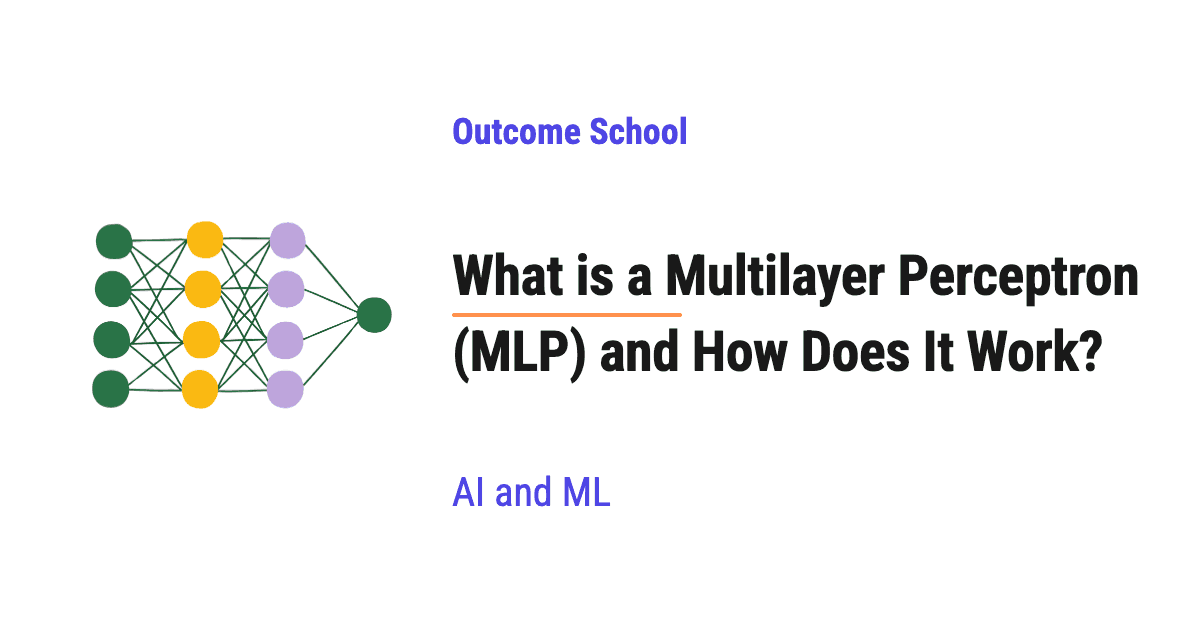
What is a Multilayer Perceptron (MLP) and How Does It Work?
A Multilayer Perceptron (MLP) is a neural network made of layers of simple units called perceptrons, where every unit in one layer is connected to every unit in the next layer. It works by passing numbers forward through these layers, where each unit multiplies, adds, and applies a simple rule, until the last layer gives the answer.
How does a voice agent hide the delay of a slow tool call?
A voice agent hides the delay of a slow tool call by never letting the line go silent. It speaks a short line while the tool runs, gives progress updates during a long wait, keeps the conversation going while the tool works in the background, and starts the tool early so that there is less delay to hide.