AI Agent Blogs

How does ChatGPT remember you?
ChatGPT remembers you by saving small notes about you outside the AI model and adding those notes back into the conversation whenever you chat. The model itself does not change when you chat with it, it reads your notes before it replies.
How do Browser Agents work?
Browser Agents are AI agents that use a web browser like a human does. They look at a web page, decide what to click or type, do it, look at the new page, and repeat until the task is finished.
The Future of Software Development
The Future of Software Development is a world where AI models become so smart, so fast, and so cheap that we simply tell the computer what we want, and AI agents build, test, and ship it for us. The work of software engineers moves from writing every line of code to building, checking, and improving the systems around these AI models.
Design a Real-Time Voice AI Agent
A Real-Time Voice AI Agent listens to us, understands, thinks, takes actions, and talks back in a natural voice within a fraction of a second. Let's design one.
What is Graph Engineering?
Graph Engineering is designing an AI system as a graph, where every step is a node and every path between steps is an edge, instead of one giant prompt.
What is Loop Engineering?
Loop Engineering is designing the repeating cycle that an AI agent runs, so that it keeps making real progress on a task and stops at the right moment.
What are Agent Skills?
An Agent Skill is a folder of instructions, and optionally scripts, that an AI agent loads by itself only when the task needs it. Let's see how Skills work.
What is MCP (Model Context Protocol)?
MCP (Model Context Protocol) is an open standard that defines one common way for AI applications to connect to outside tools and data. It was created by Anthropic.
What is OKF (Open Knowledge Format)?
OKF (Open Knowledge Format) is an open standard for writing what an organization knows about its data as plain markdown files that any AI agent can read.
How does LangGraph work?
LangGraph is a framework to build LLM applications where the work is organized as a graph of steps, with nodes, edges, and a shared state.
How does LangChain work?
LangChain is a framework that helps us build LLM applications by connecting the LLM with our data, tools, and logic through chains, memory, and agents.
How do Computer-Use Agents work?
A computer-use agent is an AI program that operates a computer like a human. It looks at the screen, moves the mouse, clicks, and types to finish our goal.
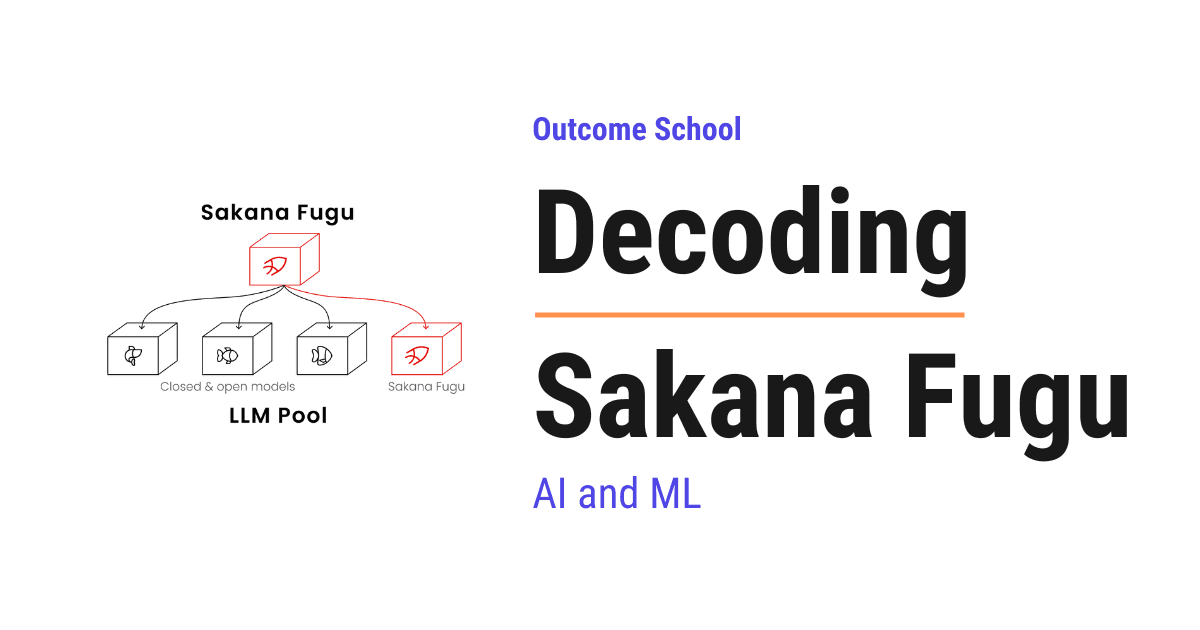
What is Sakana Fugu? The Technical Report Explained
Sakana Fugu is a family of AI models that work like a conductor. They decide which other AI models should work on our question and combine their answers.
How does Function Calling work in LLMs?
Function Calling lets an LLM use external tools and APIs. The model does not run the function itself. It tells our code which function to call and with what inputs.
What is an AI Agent Loop?
The AI Agent Loop is the code that runs an AI Agent. It asks the LLM what to do, runs that action, feeds back the result, and repeats until the task is done.
What is AI Agent Observability? Traces, Spans, and Metrics Explained
AI Agent Observability means recording every step an AI Agent takes, like each thought and tool call, so that we can see why it behaved the way it did.
How AI Agents Communicate
AI agents communicate by sending messages to each other to share information, ask for help, and work together. We will learn the main ways and protocols.
What are AI SubAgents? Why We Need Them and How They Work
An AI SubAgent is a smaller, specialized agent that works under a main agent to handle one part of a big task, like a team member under a manager.
How to Evaluate AI Agents? Metrics, Methods, and Best Practices
AI Agent Evaluation is the process of measuring how well an AI Agent performs a task, by checking the final result, the steps it took, and the tools it used.
What is AI Orchestration? How It Works and the Common Patterns
AI Orchestration is the process of coordinating many AI parts, like LLMs, tools, data sources, and agents, so that they work together to finish a complex task.
What is Context Engineering?
Context Engineering is the practice of deciding what information goes into an LLM's context window, and how, so that the model can do its task reliably.
What is a Reflection Agent? How It Generates, Critiques, and Revises
A Reflection Agent is an AI Agent that writes a draft, critiques its own draft, and then writes a better version using that critique, again and again.
What is GraphRAG? How Knowledge Graphs Improve RAG
GraphRAG is RAG that uses a knowledge graph along with vector search to find better, more connected information before the LLM answers a question.
What is a Plan-and-Execute Agent and How Does It Work?
A Plan-and-Execute Agent is an AI Agent that first writes the full plan up front and then runs the plan step by step. Let's see how it differs from ReAct.
What is Agentic RAG? How It Works and When to Use It
Agentic RAG is a RAG system where an AI Agent decides when to search, what to search, and when to stop, instead of doing one fixed search before answering.
What is a ReAct Agent? How It Thinks and Acts, Explained
A ReAct Agent is an AI Agent built using the ReAct (Reasoning + Acting) pattern. It runs in a loop where the LLM thinks, takes an action, and observes the result.
What are Multi-Agent Systems and When Should We Use Them?
A Multi-Agent System is a setup where two or more LLM-driven agents, each with its own prompt and tools, work together on a shared task. Let's see when to use one.
How Does AI Agent Memory Work? The Memory Stack Explained
AI Agent Memory is the system that lets an LLM remember things across messages, sessions, and users. We will learn the memory stack and how it works.
What is an AI Agent? How It Works
An AI Agent is a system where an LLM takes a goal, decides the steps, uses tools, and keeps working in a loop until the goal is done. We will learn how it works.
What is Harness Engineering?
Harness Engineering is building the layer of code around an AI model that manages its inputs, outputs, tools, memory, errors, and evaluation for production.